


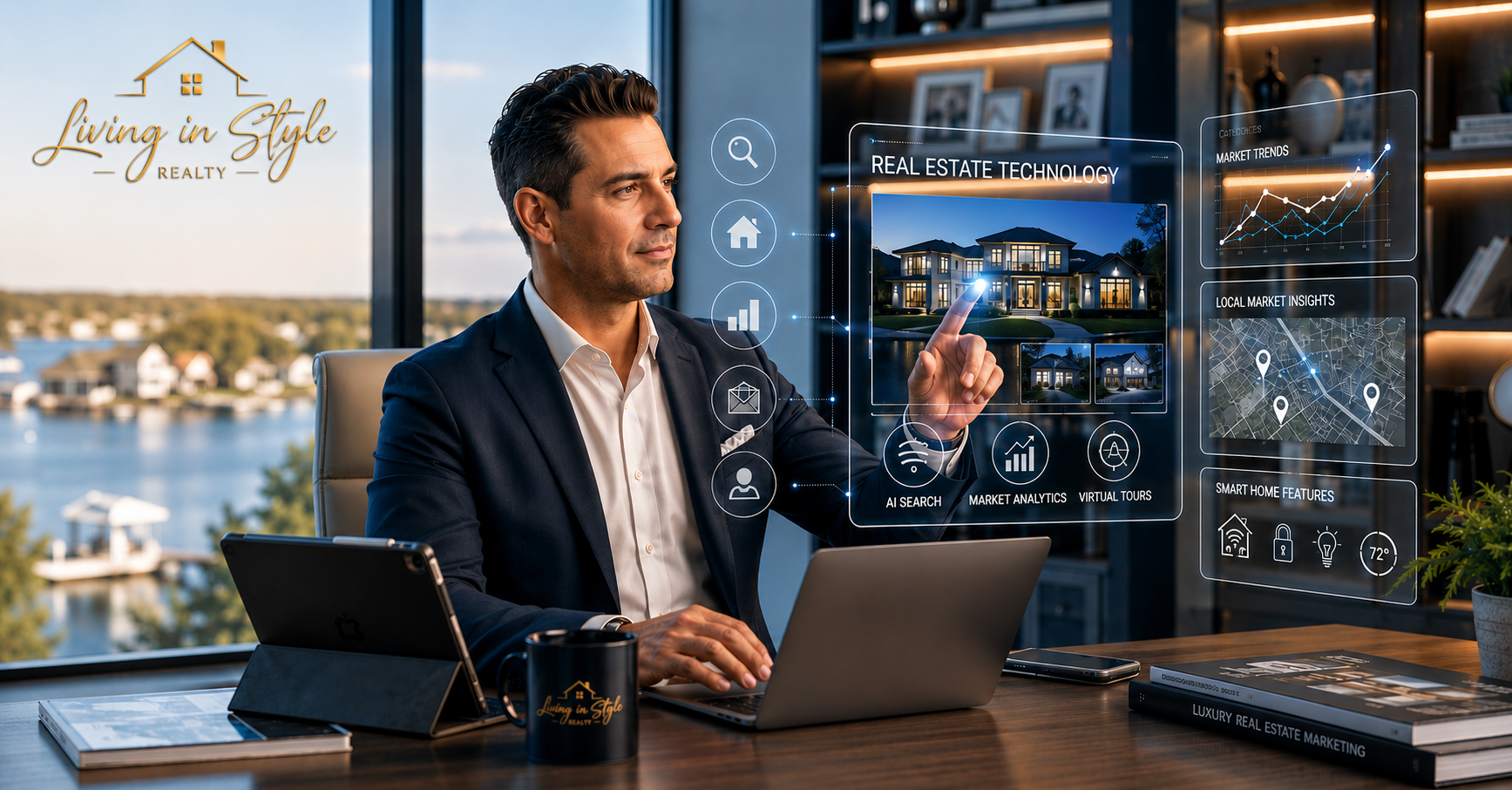
In Real Estate, Staying Ahead of Technology Means Staying Ahead of the Market
Technology has always influenced the real estate industry, but today, the pace of change is dramatically different. Artificial intelligence, predictive analytics, CRM automation, digital marketing, virtual staging, smart-home technology, electronic transactions, AI-powered property searches, and generative search platforms are changing how buyers find homes, how sellers evaluate agents, and how real estate professionals operate their businesses.
The real challenge is no longer simply using technology.
It is staying current with technology as it evolves.
A platform, marketing strategy, AI tool, or digital workflow that was considered innovative two years ago may already be outdated—or significantly improved—today. For real estate professionals who want to remain competitive, relevant, and valuable to their clients, continuing technology education has become part of the job.
Technology Is Now Part of the Real Estate Experience
Consumers increasingly expect convenience, speed, transparency, and access to information. They search for homes online, research neighborhoods digitally, communicate through mobile devices, sign documents electronically, view professional photography and video, and increasingly use AI-powered search tools to ask complex real estate questions.
According to the National Association of REALTORS® 2025 Technology Survey, 79% of REALTORS® surveyed used eSignature technology, 75% used social media, and 52% used drone photography or video. Even more telling, 82% reported that their clients responded positively or very positively to technology being integrated into the buying and selling process.
Technology isn't replacing professional service. When properly used, it can make that service faster, more informed, more responsive, and more personalized.
Artificial Intelligence Is Accelerating the Change
AI may represent one of the biggest technological shifts real estate has experienced in decades.
Today's AI capabilities extend far beyond writing listing descriptions. Real estate professionals can use AI-assisted technologies for marketing, lead generation, market research, predictive analytics, CRM workflows, content development, client communication, property data analysis, and operational efficiency.
The technology continues to advance rapidly. In 2026, the National Association of REALTORS® highlighted the evolution from traditional AI chatbots toward systems capable of handling more complex, multistep workflows. The organization continues to emphasize an important principle: technology can perform more of the heavy lifting, while human judgment remains critical.
That distinction matters.
The goal isn't to replace real estate expertise with AI. The goal is to combine better technology with stronger human expertise.
Staying Current Is More Important Than Simply Owning the Technology
Having an expensive CRM, sophisticated website, AI subscription, or marketing platform doesn't automatically create a competitive advantage.
Knowing how to use it does.
Technology changes too quickly for real estate professionals to assume that learning a platform once is enough. Software updates. Algorithms change. Search behavior evolves. New integrations become available. AI capabilities improve. Consumer expectations shift.
The REALTORS® Technology Survey found that 59% of REALTORS® were using some emerging technology but were still learning how to use it.
That statistic highlights an important reality: technology education is becoming an ongoing process rather than a one-time investment.
AI Search Is Changing How Consumers Discover Real Estate Professionals
Traditional search engine optimization remains important, but online discovery is expanding beyond conventional search results.
Consumers can now ask AI-powered platforms highly specific questions such as:
"Who is a real estate agent specializing in luxury homes around Lake Norman?"
"What should I know before buying waterfront property in North Carolina?"
"How much could my home be worth in today's market?"
"What neighborhoods near Charlotte offer luxury homes with access to Lake Norman?"
Search itself is becoming more conversational. In May 2026, Google described major expansions to its AI-powered Search experience, including increasingly sophisticated AI and agent-based capabilities.
For real estate professionals, that means their digital strategy should increasingly consider SEO, AEO (Answer Engine Optimization), GEO (Generative Engine Optimization), AI search visibility, local authority, structured information, and natural-language content.
The question is no longer simply:
"Can someone find my website on Google?"
It is becoming:
"Can search engines and AI systems understand who I am, where I work, what I specialize in, and why I may be relevant to the consumer's question?"
Technology Can Strengthen Local Expertise—Not Replace It
This is particularly important in markets such as Lake Norman, Charlotte, Mooresville, Cornelius, Davidson, Huntersville, Denver, and surrounding North Carolina communities.
Technology can analyze enormous amounts of information, but successful real estate decisions still require context.
A knowledgeable real estate professional can interpret information about neighborhood characteristics, property condition, comparable sales, location, marketability, negotiation strategy, buyer behavior, seller expectations, and countless details that raw data alone may not fully explain.
The strongest real estate model moving forward will likely combine advanced technology + current market intelligence + local knowledge + experienced human judgment.
Technology Is Also Changing How Properties Are Marketed
Modern property marketing can now incorporate professional photography, aerial imagery, video, virtual tours, digital advertising, social media campaigns, virtual staging, automated lead nurturing, targeted databases, AI-assisted content, and sophisticated property websites.
But again, simply having access to these tools isn't enough.
Real estate professionals must continuously ask:
Is this technology still effective?
Has something better become available?
Has consumer behavior changed?
Can this platform integrate with another system?
Is AI making this workflow faster?
Are there compliance, copyright, privacy, or Fair Housing concerns?
Could automation improve response times without sacrificing personalized service?
That last point is especially important. NAR identifies significant opportunities for AI in real estate while also emphasizing concerns involving privacy, Fair Housing, copyright, data usage, and responsible implementation.
Staying technologically current also means staying educated about the responsibilities that come with using that technology.
The Best Technology Should Make Real Estate More Personal
Ironically, the greatest benefit of technology may be its ability to give professionals more time to be human.
Automation can handle repetitive administrative work.
CRMs can help ensure clients aren't forgotten.
AI can help organize information.
Digital signatures can accelerate transactions.
Integrated platforms can reduce duplicate work.
NAR has noted that when real estate technology platforms work together effectively, agents can regain time, improve clarity, and help transactions move more efficiently.
That additional efficiency allows a real estate professional to spend more time where experience matters most: advising, negotiating, communicating, problem-solving, strategizing, and building relationships.
The Competitive Advantage Is Continuous Learning
Real estate professionals don't necessarily need to adopt every new piece of technology that appears.
They do, however, need to understand what is changing.
The smartest approach is to continually learn, test, evaluate, integrate, and refine.
Some technologies will dramatically improve a business. Others will disappear almost as quickly as they arrived. The professional advantage comes from understanding the difference.
In today's market, saying "I've always done it this way" can quickly become a competitive disadvantage.
The better question is:
"Is there now a better way to serve my client?"
That mindset keeps technology focused where it belongs—on improving the real estate experience.
Technology Changes. Experience Still Matters.
Real estate will always be a relationship-driven business.
Buying or selling property involves financial decisions, negotiations, emotions, timing, strategy, and often major life transitions. No algorithm completely replaces the importance of having an experienced professional sitting beside you when an important decision needs to be made.
But experienced professionals also cannot ignore the technology reshaping their industry.
The future belongs to real estate professionals who can successfully combine experience with innovation, local expertise with data, personal relationships with intelligent automation, and traditional real estate knowledge with emerging AI capabilities.
Technology will continue to evolve.
Our responsibility as real estate professionals is to evolve with it.
Ready for a More Modern Real Estate Experience?
At Living In Style Realty, I believe today's clients deserve more than traditional real estate service. My approach combines decades of real estate experience, local market knowledge, strategic negotiation, modern marketing, and advanced technology to help buyers and sellers make informed decisions throughout Lake Norman and surrounding North Carolina communities.
Whether you're considering buying, selling, investing, relocating, or simply want to understand what today's market means for your property, let's start the conversation.
Explore properties, real estate resources, and local market expertise at Living In Style Realty.
Check out this article next