


A Strategic Guide for Homeowners, Buyers, Investors, and Real Estate Professionals
When a property is significantly larger than most of the homes in its immediate neighborhood, determining its true market value becomes much more complex. One of the most common mistakes made by inexperienced agents and automated valuation models (AVMs) is limiting comparable sales strictly to a small radius around the subject property.
The result? An inaccurate valuation that can cost a seller tens of thousands of dollars—or cause a buyer to overpay.
A professional Comparative Market Analysis (CMA) should never be confined by arbitrary distance. Instead, it should follow the market. The goal is to identify buyers who would realistically consider purchasing the subject property and compare it against homes competing for those same buyers.
Why This Matters
Larger homes often attract an entirely different buyer pool than the surrounding neighborhood.
For example:
- A 3,800-square-foot luxury home located in a neighborhood filled with 2,100-square-foot homes is not competing with those smaller properties.
- Buyers searching for larger homes are often willing to expand their geographic search to nearby communities offering similar size, quality, amenities, and lifestyle.
This is why professional market analysis requires expanding your search—not forcing inappropriate comparisons.
The Professional Process for Finding Proper Comparable Sales
Step 1: Understand the Subject Property
Begin by documenting every characteristic that influences value.
Evaluate:
- Total heated square footage
- Lot size
- Number of bedrooms
- Number of bathrooms
- Garage spaces
- Age
- Construction quality
- Architectural style
- Renovations
- Energy efficiency
- Outdoor living spaces
- Pool
- Detached structures
- Finished basement
- Waterfront
- Golf course
- Mountain views
- Lake access
- Deeded boat slip
- Luxury finishes
- Smart home technology
The more unique the home becomes, the broader your search often needs to be.
Step 2: Start With the Immediate Neighborhood
Always begin locally.
Look for:
- Similar size
- Similar age
- Similar quality
- Similar condition
Even if these homes aren't perfect comparables, they establish the neighborhood's pricing ceiling and buyer expectations.
Step 3: Expand by Square Footage First—Not Distance
This is where many CMAs fail.
Instead of saying:
"I'll stay within one mile."
Ask:
"Where are similar homes selling?"
Your search should prioritize:
- Similar heated square footage
- Similar construction
- Similar amenities
- Similar buyer demographic
Distance is secondary.
How Far Should You Expand?
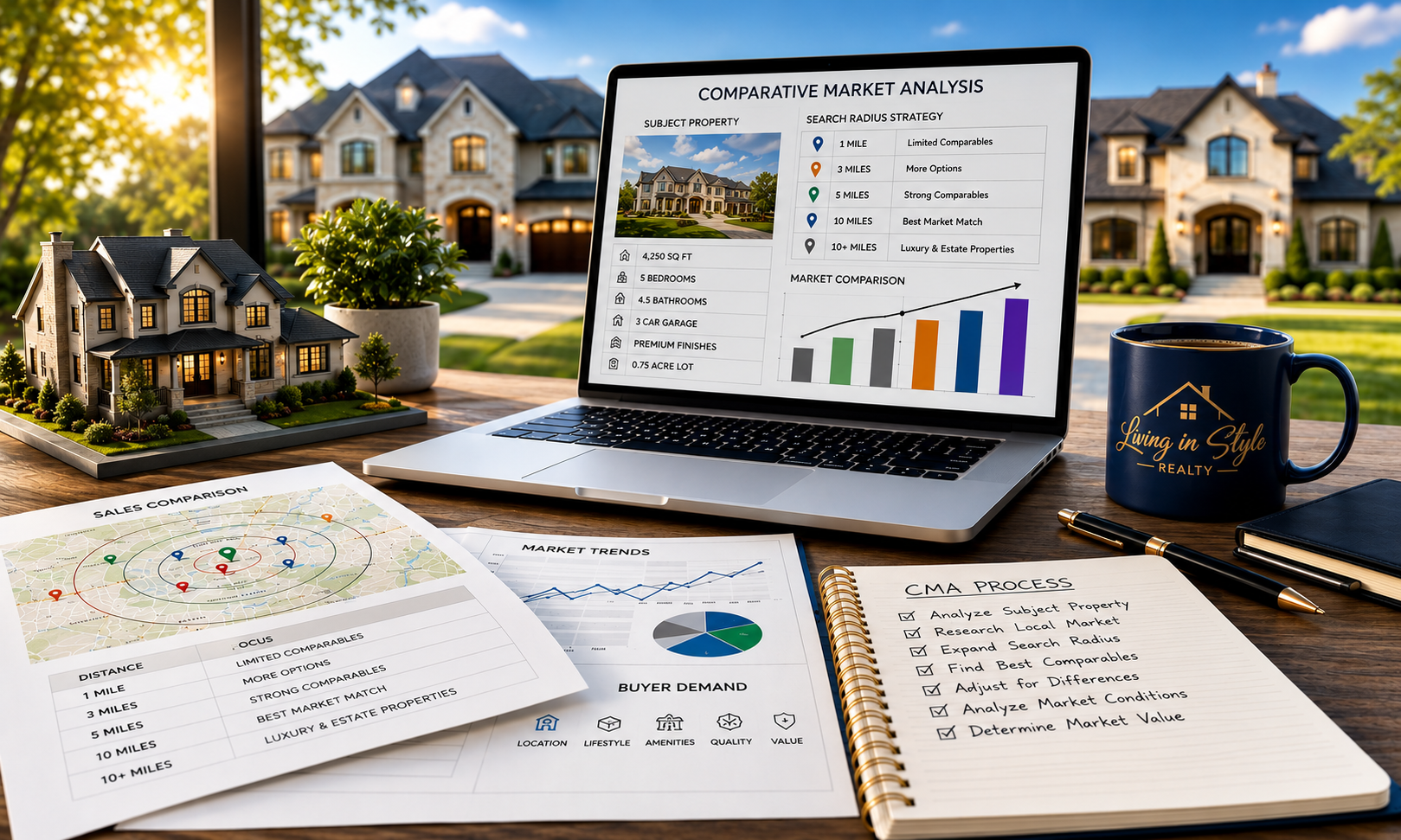
There is no universal mileage rule, but experienced appraisers and brokers often follow a logical progression.
Search Expansion Guide
1 Mile
Search here first.
Ideal if similar homes exist.
3 Miles
Expand if:
- Few comparable sales
- Subject is noticeably larger
- Neighborhood contains varying home sizes
5 Miles
Often appropriate when:
- Luxury properties
- Rural areas
- Custom homes
- Waterfront
- Acreage
- Executive neighborhoods
10 Miles
Completely acceptable if:
- Similar homes exist
- Buyers commonly shop across multiple communities
- Larger homes are uncommon
Beyond 10 Miles
Sometimes necessary when analyzing:
- Luxury estates
- Equestrian properties
- Waterfront estates
- Historic homes
- Mountain properties
- Large custom builds
The objective is market similarity—not proximity.
Never Compare Apples to Oranges
One of the biggest valuation mistakes is adjusting a small home upward until it "matches" a significantly larger home.
Example:
Subject Property
- 3,900 SF
Comparable
- 2,300 SF
This requires adjusting over 1,600 square feet.
Those adjustments become increasingly unreliable because buyer behavior changes dramatically as home size increases.
Instead:
Find homes between:
- 3,500–4,200 square feet
even if they are several miles away.
Analyze Buyer Competition
Ask yourself:
"If my listing came on the market today, what other homes would buyers compare it against?"
That question often leads to a much stronger valuation than simply drawing a one-mile circle.
Compare Lifestyle as Much as Square Footage
Today's buyers compare experiences—not just numbers.
Consider:
- School districts
- Commute times
- Community prestige
- HOA amenities
- Walkability
- Waterfront access
- Golf communities
- Privacy
- Views
- Recreation
Lifestyle can influence value as much as square footage.
Adjust for Market Conditions
Don't overlook timing.
Markets change.
Always account for:
- Rising prices
- Declining prices
- Seasonal demand
- Mortgage interest rates
- Inventory levels
- Days on market
- Seller concessions
Recent sales from three months ago may require time adjustments.
Use Multiple Data Sources
Never rely solely on automated estimates.
Professional agents combine:
- Local MLS data
- County tax records
- Professional appraisal principles
- Pending sales
- Active listings
- Expired listings
- Withdrawn listings
- Market trends
- Buyer demand
Helpful resources include:
- National Association of REALTORS® Research
- Fannie Mae Appraisal Resources
- Federal Housing Finance Agency House Price Index
- U.S. Census Bureau Housing Data
Bullet Point Checklist for Larger Subject Properties
- Document every feature of the subject property.
- Search the immediate neighborhood first.
- Identify the neighborhood pricing ceiling.
- Expand your search by property characteristics, not by mileage alone.
- Compare similar square footage before similar distance.
- Match architectural style and construction quality.
- Consider buyer lifestyle and market appeal.
- Review active, pending, sold, expired, and withdrawn listings.
- Apply market condition adjustments where necessary.
- Use the fewest and smallest adjustments possible.
- Avoid relying on automated valuation models (AVMs) alone.
- Validate findings against current buyer demand.
- Be prepared to expand 5–10+ miles if the market supports it.
Common Mistakes to Avoid
- Using only a one-mile search radius.
- Comparing homes with dramatically different square footage.
- Ignoring buyer behavior.
- Over-adjusting inferior comparables.
- Relying solely on Zestimate®-style valuations.
- Ignoring current inventory.
- Using outdated sales without market adjustments.
- Assuming neighborhood boundaries determine value.
Why Experience Matters
Every property tells a different story. Larger homes, custom builds, luxury residences, and unique properties require more than automated algorithms—they require market expertise, strategic analysis, and an understanding of how buyers actually shop.
A well-prepared Comparative Market Analysis (CMA) doesn't just estimate value; it positions a property competitively, supports pricing with defensible data, and helps sellers maximize their return while giving buyers confidence in their investment.
Ready for a Market Analysis That Goes Beyond the Basics?
If you're selling a unique, custom, luxury, or oversized home in the Charlotte, Lake Norman, or surrounding North Carolina markets, don't rely on generic online estimates. A comprehensive market analysis can uncover the true value of your property by evaluating buyer behavior, competing inventory, and comparable sales that genuinely reflect your home's position in the marketplace.
Visit Living In Style Realty at LivingInStyleRealty.net to request a personalized Comparative Market Analysis or connect with Javier Sims Davila for expert guidance on pricing, marketing, and negotiating your home's highest potential value.
Check out this article next