


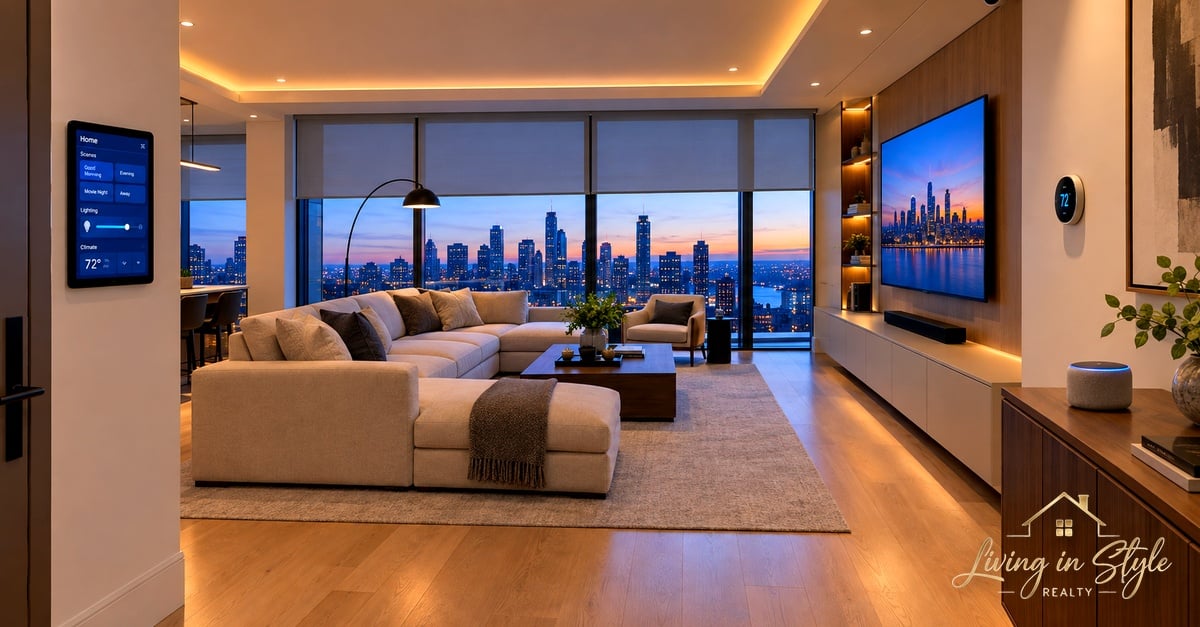
"The Right Tech and Efficiency Upgrades Pay You Back — The Wrong Ones Just Sit There Unused"
Quick Answer: The smart-home and sustainable features with the strongest track record for resale value are security systems, EV chargers, smart electrical panels, and solar-ready wiring — not whole-home custom automation. Solar-ready infrastructure alone can add 2–4% to resale value for roughly a $1,000 build-stage cost, according to BuilderMuse, while flashy proprietary automation systems show low buyer demand, per NAR-sourced research.
New construction buyers today aren't just comparing square footage and floor plans — they're asking about smart thermostats, EV chargers, solar-ready wiring, and energy ratings before they ever get to paint colors. According to the 2025 NAR Sustainability Report cited by OwnLuxuryHomes, 72% of real estate professionals say utility costs are now a top priority for their clients, and Shelton Group's Energy Pulse study found that up to 80% of people planning to buy or build a home are more likely to choose one that's energy efficient — with 71% saying they're likely to pay more for it. The demand is real. But not every "smart" or "green" feature a builder advertises actually holds its value, and it's easy to overpay for tech nobody will use or miss upgrades that quietly cost thousands to retrofit later.
Key takeaways:
Smart features factor into 11% of purchase decisions and can add up to a 5% resale premium — but only certain features drive that number (NAR).
Solar-ready wiring costs about $1,000 to add during framing and can return $8,000–$16,000 in resale value on a $400,000 home (BuilderMuse).
North Carolina does not mandate solar-ready construction, so it's a differentiator, not a given — buyers should ask for it directly.
Whole-home custom automation has low buyer demand; EV readiness and smart electrical panels have rising demand.
Always ask for a HERS rating or ENERGY STAR certification instead of relying on marketing language like "eco-friendly" or "high-performance."
Here's what to prioritize when you're touring new construction in Mooresville, Huntersville, Cornelius, or Davidson — and where buyers most often get it wrong.
1. What Smart Home Features Actually Add Value in New Construction?
Security systems, smart thermostats, EV chargers, and fiber internet infrastructure all rank as very high or high in buyer demand, and EV charging in particular is shifting from a luxury add-on to a standard expectation in competitive markets, according to NAR-sourced research on smart home value. Roughly 11% of recent buyers say smart features were a specific reason they chose their home, and the same research puts the resale premium from smart features at up to 5%.
Pitfall to Avoid: Getting excited about a builder's whole-home custom automation package. That same research shows buyer demand for these systems is low — most people don't want to learn a proprietary interface, and a system tied to one builder's app can actually make a home harder to sell down the road.
2. How Do I Confirm a New Build's Energy-Efficiency Specs Before Closing?
Get every efficiency spec written into your purchase contract, not just shown in the model home. NAHB's consumer preferences survey of more than 3,600 recent and prospective buyers found that multi-zone HVAC, lighting controls, and programmable thermostats consistently rank as the most-wanted energy-related features — and that most buyers are willing to pay more for a genuinely energy-efficient home.
Pitfall to Avoid: Assuming the insulation grade, HVAC zoning, or window package in the decorated model home is what you're actually getting. Builders frequently upgrade model homes for showing purposes. Confirm every efficiency spec in writing, not verbally on a walkthrough.
3. Is Solar-Ready Wiring Worth It If I'm Not Installing Panels Yet?
Yes — solar-ready infrastructure resells for 2% to 4% more than comparable homes without it, even if you never install panels. North Carolina doesn't currently mandate solar-ready construction the way California, Washington, Oregon, and eleven other states now do, according to BuilderMuse's state-by-state breakdown — but that same research shows the resale premium can mean $8,000 to $16,000 in added value on a $400,000 home, for roughly a $1,000 builder-stage investment. That source also finds 60–70% of buyers already consider solar capability an important feature, even if they don't plan to install panels right away.
Pitfall to Avoid: Skipping solar-ready infrastructure to save a small amount at the build stage. Retrofitting conduit and panel capacity after drywall goes up costs far more than adding it during framing — and it's one of the few upgrades with documented resale data behind it.
4. Which Smart-Home Upgrades Are Worth the Money at Resale?
Prioritize smart electrical panels and EV-ready circuits over fully integrated automation suites. Not every dollar spent on technology comes back to you at resale — whole-home custom automation and many smart-appliance packages show low buyer demand, while smart electrical panels are rising fast in markets with strong solar and EV adoption, according to NAR-based smart home data.
Pitfall to Avoid: Pouring your upgrade budget into a flashy, fully integrated automation system while skipping a smart electrical panel or EV-ready circuit — the feature with rising, durable demand often costs less than the one that photographs well but doesn't move the needle for the next buyer.
5. How Can I Tell If a Builder's "Eco-Friendly" Claims Are Real?
Ask for a HERS rating, ENERGY STAR certification, or documented insulation and window performance numbers — not just a brochure that says "sustainable." The Shelton Group researchers behind the Energy Pulse study specifically flagged homebuilder marketing as "riddled with" buzzwords that don't tell buyers what they're actually getting.
Pitfall to Avoid: Taking a builder's sustainability claims at face value. A verified certification protects you at resale; a marketing phrase does not.
Conclusion
Smart-home and sustainability features in new construction aren't one-size-fits-all upgrades — some pay for themselves at resale, and some are just expensive novelties. The buyers who come out ahead are the ones who separate documented, high-demand features (security systems, EV readiness, solar-ready wiring, verified efficiency ratings) from the flashy extras that sound good in a sales presentation but rarely move resale value. Get every spec in writing, ask for certifications instead of buzzwords, and prioritize the upgrades that are cheap to add during the build and expensive to retrofit later.
Ready to Build Smart in the Lake Norman Market?
If you're evaluating new construction in Mooresville, Huntersville, Cornelius, Davidson, or anywhere across the Lake Norman corridor, I can help you separate the builder upgrades worth paying for from the ones that just look good on a walkthrough. Contact Javier Sims Davila at Living In Style Realty — call 704-870-7057 or visit LivingInStyleRealty.net to schedule a consultation before you sign a builder contract.
Check out this article next